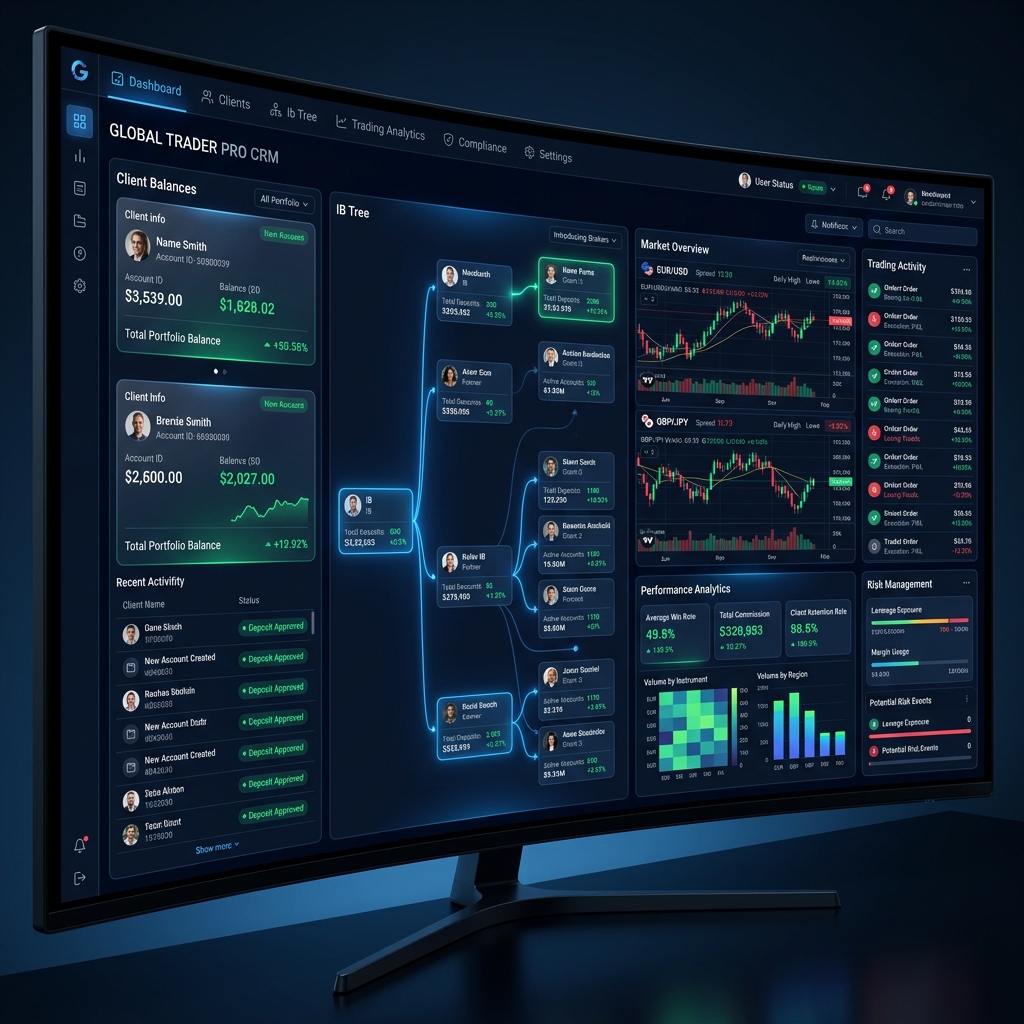
A CRM — Customer Relationship Management software — was architected to manage relationships. Contacts, pipelines, emails, follow-ups. Salesforce is a CRM. HubSpot is a CRM. They're genuinely excellent at what they do.
A Traders Room — sometimes called a client cabinet, client portal, or back office — is a different animal entirely. It's a financial operations platform. It's where your clients actually do the thing they came to do: deposit money, withdraw money, open live accounts, verify identity, adjust leverage settings, and move funds between accounts.
The difference isn't cosmetic. It's structural. One tracks relationships. The other facilitates real-money transactions. Mixing them up is precisely how you build a brokerage that looks polished from the outside and hemorrhages operational chaos from within.
What's Actually Inside a Trader's Room?
Abstract explanations only stretch so far. Let's get concrete.
A proper Traders Room has a client-facing side and an admin-facing side. On the client side, traders log in and see their accounts. They fund those accounts via Skrill, Neteller, bank wire, or crypto. They submit withdrawal requests, upload KYC documents, and pull a live feed of their trading history. Clean. Self-contained.
On your side: everything, in real time. You see who deposited, who's queued for withdrawal, who abandoned their KYC halfway through, which IBs are generating serious volume, and what your financial exposure looks like at this exact moment. Not yesterday's spreadsheet, not a report someone manually compiled on Friday afternoon.
Think about the last time you tried to reconstruct a client's deposit history from three separate spreadsheets and a Slack thread at 4 pm on a Friday. That's exactly the problem this solves.
Where Forex CRMs Fall Short
The forex industry has something called a "Forex CRM," which is where the terminology starts to slide around dangerously.
A Forex CRM is a sales and marketing instrument adapted for brokerages. Leads arrive, they drop into the CRM, an IB or retention agent picks them up, works the relationship, logs calls, fires off emails. Good ones do this reasonably well.
But here's where brokers consistently blunder. They assume the CRM is the system. That having a Forex CRM means operations are covered. Then reality sets in: clients have nowhere to log in and manage their accounts. Every deposit goes through support. Every withdrawal is a manual ticket.
That's not a business. That's a support team slowly drowning while pretending to swim.
The Integration Question
Some platforms try to fuse both worlds, and when it actually works, it's genuinely elegant. You get a unified back office where the client portal, CRM functionality, IB management module, payment gateway integrations, and MT4/MT5 bridge are all communicating in real time.
In practice, that unified architecture reduces friction. Your IB notices a client deposited $10,000 last night — they know to call this morning. Your compliance team catches a withdrawal request from an account that has been dormant for 18 months — they flag it before it clears.
But integration only works if the underlying Traders Room is actually strong. If the client-facing portal is clunky, no amount of backend CRM sophistication compensates.
The IB Module Deserves Its Own Conversation
One feature native to a Traders Room — something you basically never encounter in a standard CRM — is the Introducing Broker (IB) management module.
Managing IB relationships manually — tracking referrals, calculating commissions, generating statements — is extraordinarily tedious. A Traders Room automates this entirely. IBs get their own login. They see their referral links, active clients, and pending commissions without ever contacting your support team.
Compliance and KYC (CRMs Don't Cut It)
Regulatory requirements for forex brokerages have become genuinely intense over the last decade. A Traders Room has document management woven into its operational logic. Clients upload their passports and proof of address directly through the portal.
A standard CRM might let you attach files to a contact record. That's not a compliance workflow. There's no automatic logic linking account status to KYC approval — nothing is preventing a withdrawal from being processed before verification completes.
The Compliance IncidentIf you enforce KYC rules manually via email or a spreadsheet, eventually, on some chaotic Tuesday, someone on your team forgets. A non-verified client manages to withdraw funds. Now you have a serious compliance breach.
The Real Difference, Summed Up Bluntly
A CRM manages people. A trader's room manages money and accounts.
Your CRM knows that John Smith is a lead from Germany who clicked your Facebook ad in March. Your Traders Room knows that John Smith holds two MT5 accounts, deposited €5,000, has a pending withdrawal for €1,200 queued right now, and cleared KYC on March 15th.
Both kinds of information matter. But attempting to run financial operations through a tool built for tracking human sentiment is exactly how operational problems quietly compound into serious structural failures.
The brokerages that scale well understand this distinction early. They invest in proper Traders Room infrastructure as the foundation for everything else, and they deploy their CRM for what it's actually good at. Two different jobs. Two different tools.