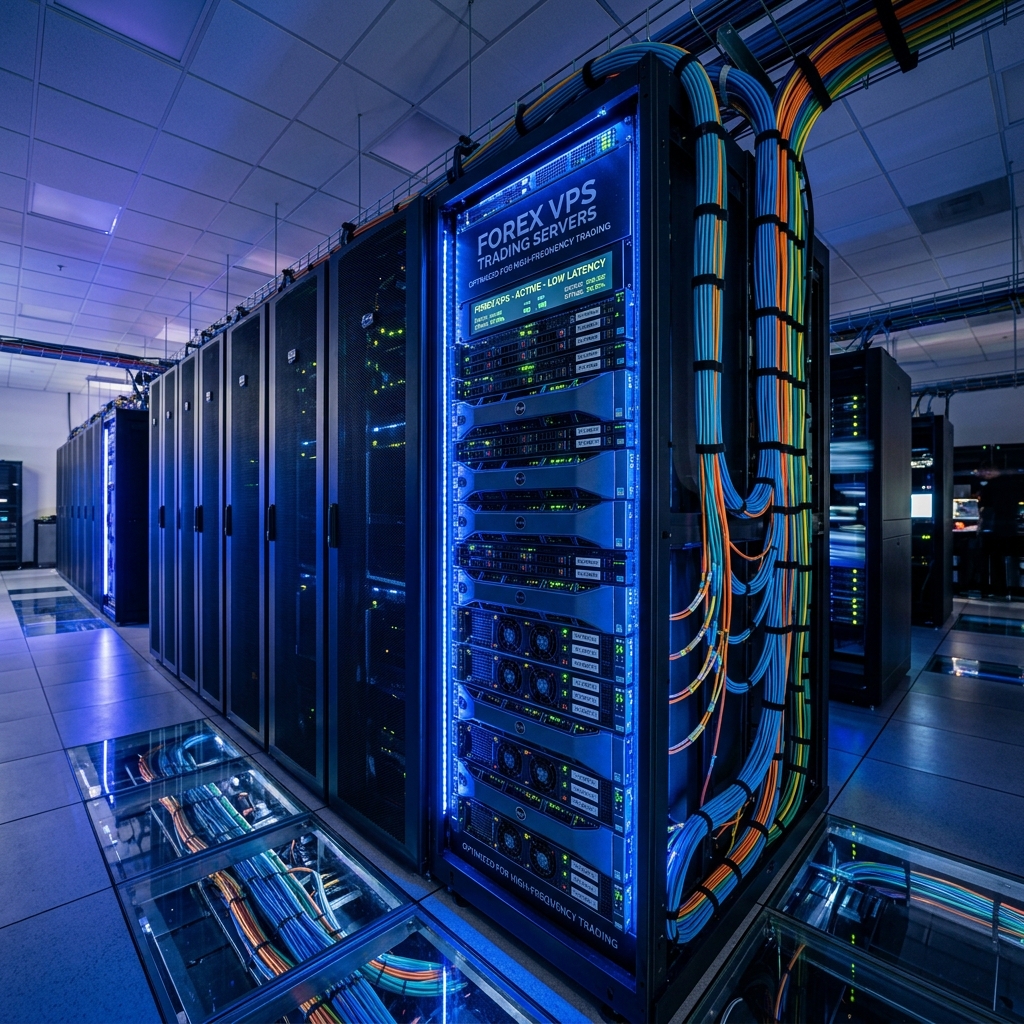
There's a conversation that happens in basically every trading group: Someone posts strategy results, everyone is impressed, then someone asks, "But where's your server hosted?" The mood shifts because half the room realizes they've been optimizing the wrong thing entirely.
Location matters. Not in a "latency is kind of important" way — in a "you're bleeding money every single millisecond your order spends in transit" way.
So let's talk about the three data centers that actually matter for MT5 traders: LD4 in London, NY4 in New York, and TY3 in Tokyo. These aren't geographic labels slapped on a map. They're physical buildings where the world's major liquidity providers, prime brokers, and matching engines actually live, hum, and transact.
Choosing the wrong one for your setup is, without exaggeration, one of the most expensive mistakes I see retail traders make repeatedly without ever connecting it to their P&L.
A Quick Reality Check on Latency
When your MT5 server fires an order toward a broker's execution engine, that signal crawls through fiber-optic cables, switches, and routers before it lands and is confirmed. That round trip is your latency. We measure it in milliseconds — sometimes microseconds for the serious stuff.
For a swing trader holding for days? Irrelevant. But if you're running algos, scalping, or arbitrage — or you want clean fills on news events — the gap between 0.3ms and 30ms is enormous. We're talking about whether your order gets the price you wanted or slips to something worse while the market laughs at you.
The brokers know this, which is why their routing servers are colocated inside these specific buildings.
LD4: Built Its Reputation on FX
Equinix LD4 sits in Slough, England — just outside London. It's probably the single most important data center in retail forex. Full stop. If you asked me to bet on where most major MT5 broker servers are physically humming right now, I'd say LD4 without blinking.
London is the world's largest FX hub — something like 38–40% of global foreign exchange volume flows through it. Prime brokers cluster there, and EBS Market, one of the two dominant interbank FX platforms, has infrastructure anchored to that region. Price discovery for the majors essentially happens next door when you colocate in LD4.
Trading EUR/USD, GBP/USD, or most major pairs from a broker based in LD4, with your VPS inside the same building, can get you sub-2ms round-trip times on a quiet morning.
But LD4 gets congested. London hours are brutal between 8 am and 4 pm GMT. The latency advantage is real; it's just not infinite.
NY4: Where Equities Traders Live and Die
Equinix NY4 is in Secaucus, New Jersey. The location is irrelevant, though, because what matters is who lives inside it. NY4 is the nerve center for US equities and futures. NYSE, NASDAQ, CME — their matching engines cluster around this area.
If you're trading US indices, S&P 500 CFDs, NASDAQ100, crude oil futures, or Dow Jones instruments on MT5, NY4 is basically non-negotiable.
Think about the last time you watched a news spike rip through NAS100 in under a second. That move was arguably settled before your order even finished traveling if you weren't close to the matching engine. Round-trips from NY4 to NYSE can dip under 1ms in optimal conditions. That same trip from LD4? Around 75–80ms across the Atlantic fiber. That's the difference between getting filled on the spike and watching price move 20 points away from you.
Where does NY4 get complicated? FX. North American hours carry significant volume for USD pairs, but interbank FX infrastructure isn't as tightly concentrated here as in LD4. You'll get decent forex execution from there, probably surrendering a few milliseconds on major pairs.
TY3: The Underrating Region Everyone Sleeps On
Equinix TY3 is in Tokyo. It doesn't get nearly enough credit in Western trading communities.
Here's what TY3 actually does well: The Tokyo open at 9 am JST kicks off Asian session liquidity. That's when JPY pairs move on their own terms. USD/JPY, EUR/JPY, AUD/JPY — if these are your instruments, TY3's proximity to Japanese financial institutions and the Tokyo Forex Market is a tangible edge.
Japan Exchange Group infrastructure — covering both the Tokyo Stock Exchange and the Osaka Exchange — clusters around TY3. The less-obvious benefit: TY3 latency to Sydney infrastructure is dramatically better than LD4 or NY4, making AUD and NZD pairs during Australian hours surprisingly well-served from Tokyo.
How Do You Actually Decide?
Start with your broker. Not with geography. Email their support and ask where their MT5 matching engine is physically located—not the regional server, not the backup, but the primary execution engine.
- EUR/USD, GBP/USD, European Equities: LD4
- US30, US500, NAS100, WTI Crude: NY4
- USD/JPY, Nikkei, AUD pairs during Asian hours: TY3
Use the existing latency tools. MT5 shows a live ping in the bottom-right corner of the terminal — 150ms indicates a problem. Under 10ms is solid. Under 3ms is excellent. Under 1ms means you've probably got your setup dialed in properly.
The VPS Question
Providers specifically selling "LD4 VPS" or "NY4 VPS" exist. Check whether they're actually inside the data center or merely "nearby," because that distinction matters more than the marketing copy suggests. Gaps of 10ms or more can separate a server inside LD4 from a generic data center located elsewhere in Greater London.
Don't assume a provider's location based on the name alone. "London VPS" and "LD4 VPS" are not the same thing, and the difference between them can quietly wreck a latency-dependent strategy before you've even diagnosed the problem.
What Nobody Tells You About Switching
Switching data center locations mid-strategy is weirdly disruptive. If your expert advisors have calibrated order timing, retry logic, and timeout parameters around a certain latency environment, moving from a 15ms connection to a 2ms connection will quietly shatter assumptions baked into the code.
Traders migrate to colocated setups, run the same EA, and get worse results — not because the infrastructure was wrong, but because the EA's timing logic was written expecting higher latency as a buffer… and now that buffer is gone. Plan for a recalibration period.
If you're at the level where the difference between LD4 and NY4 genuinely makes or breaks a strategy, this article is only the opening of a much longer conversation. Real edge at that tier comes from cross-connect agreements, dedicated fiber lines, and hardware timestamping. For everyone else: pick the right city for your instruments, find a broker who actually lives there, and plant your VPS inside the same building.