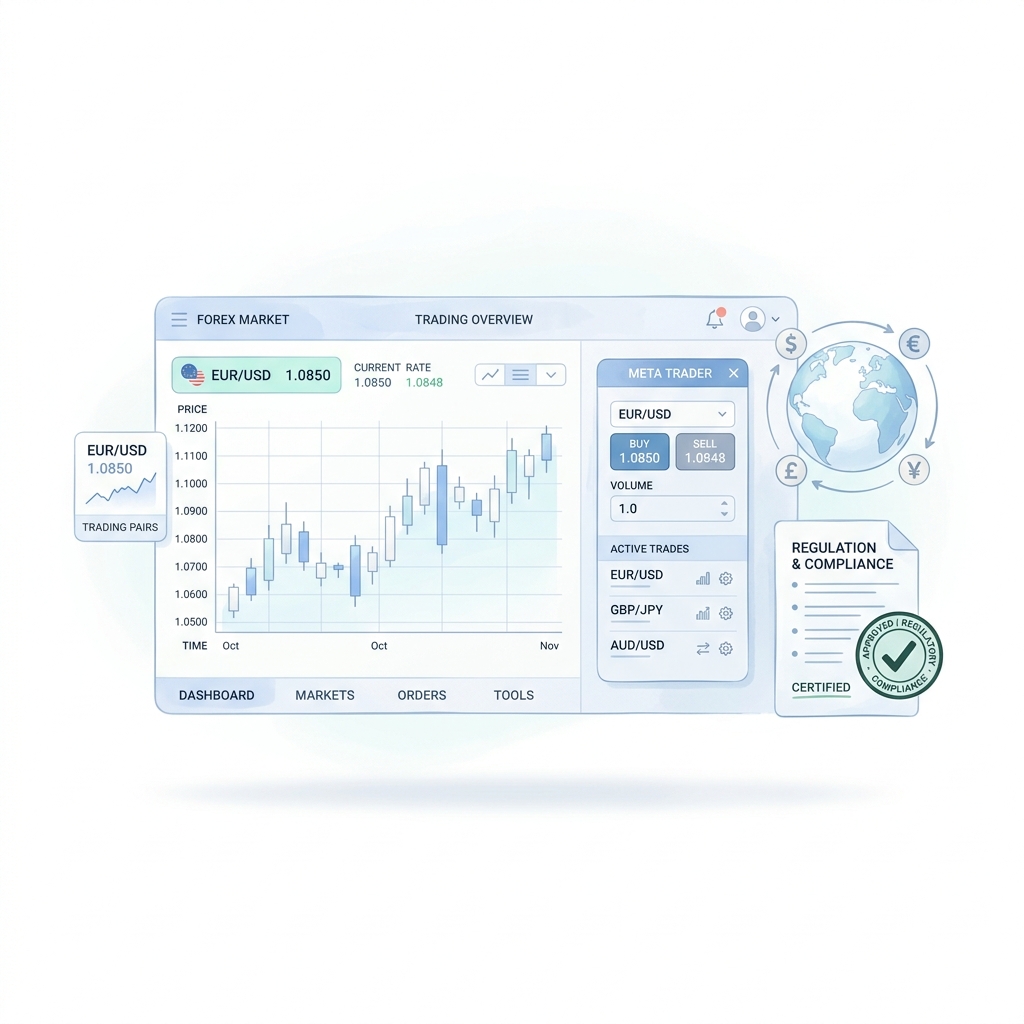
Let me be straight with you: starting a forex brokerage is one of the most capital-hungry, regulation-choked, legally treacherous ventures you can walk into. It's not a side hustle. The market is monstrous — forex turns over roughly $7.5 trillion per day. So yes, there's money — serious, structural, institutional-grade money flowing through this space constantly. The question is whether you can build something regulated, functional, and competitive inside what's become a brutally crowded arena.
Step 1: Figure Out What Kind of Brokerage You're Actually Building
Most people skip this step. They pay for that later.
There are two foundational models — Dealing Desk (DD) and No Dealing Desk (NDD). A Dealing Desk broker, often called a market maker, plants itself on the opposite side of client trades internally. That creates an obvious conflict of interest and invites regulatory scrutiny that'll follow you everywhere. NDD brokers push orders directly to liquidity providers — banks, prime brokers, ECNs — and collect spread markup or commission instead. Cleaner optics, harder to bootstrap cheaply.
Most new entrants land somewhere in the middle: an STP hybrid that looks like NDD on the surface but nets some positions internally. Which is fine — just know what you're building before you write a single check.
Are you chasing retail clients or institutional? That single decision reshapes everything — capital thresholds, platform choice, marketing approach, compliance overhead. Retail forex is where the volume lives, but it's also where regulators swing the heaviest hammers. Decide early. Decide deliberately.
Step 2: Choose Your Jurisdiction — Don't Cheap Out Here
This one makes or breaks operators. Quietly. Reliably.
Where you get licensed matters far beyond legal protection. It shapes client trust, banking relationships, and whether serious liquidity providers will even return your calls. Tier-1 jurisdictions — FCA in the UK, ASIC in Australia, CySEC in Cyprus, CFTC/NFA in the US — are expensive, slow, and worth every dollar if you're building something real.
| Regulator | Tier | Min. Capital | Timeline |
|---|---|---|---|
| FCA (UK) | Tier 1 | £730,000+ | 12–18 months |
| ASIC (Australia) | Tier 1 | AUD 1M+ | 6–12 months |
| CySEC (Cyprus) | Tier 1 | €125,000 | 6–12 months |
| CFTC/NFA (US) | Tier 1 | $20,000,000 | 12–24 months |
| FSCA (South Africa) | Tier 2 | ZAR 5M | 3–6 months |
| FSA (Seychelles) | Offshore | $50,000 | 1–3 months |
The CySEC forex license is often the entry point for European-focused brokers — it provides MiFID II passporting across all EU member states at a significantly lower capital threshold than the FCA. Targeting UK or EU retail clients without local authorization isn't a gray area — it's a regulatory enforcement action in slow motion.
Step 3: Capital Requirements and Funding
CySEC is one of the more accessible serious regulators. Even there, you're looking at €125,000 minimum capital for a CIF license under MiFID II. Sounds manageable. It isn't the whole picture.
Stack on top of that: operating reserves, liquidity buffers, technology spend, legal fees, compliance infrastructure, and staff. A realistic all-in launch budget for a properly capitalized retail forex brokerage in 2026 runs somewhere between $500,000 and $2 million. Some Malta-licensed operations have torched $3 million before executing a single live trade. That's not an edge case.
Then there's banking — increasingly brutal for forex brokers. Most traditional banks won't touch you, which means you'll end up piecing together relationships with payment service providers like Nuvei, Praxis, or Skrill alongside forex-tolerant boutique banks. Those conversations need to start while you're still inside the licensing process, not after you've launched.
Step 4: Technology Stack
Your first real decision is build, white-label, or hybrid. For almost everyone reading this, the answer is white-label to start. Building a trading platform from scratch is a multi-year, multi-million-dollar commitment that'll drain your runway before you've onboarded your hundredth client.
Trading Platform: MT5 White Label
MetaTrader 4 and MetaTrader 5 remain the industry standard. MT5 white label is the entry point — it lets you operate under an existing MetaQuotes license, dramatically reducing upfront cost compared to a direct full license (~$100,000/year). MT5 offers broader asset class support, cleaner back-office reporting, and superior architecture over MT4.
cTrader is a legitimate alternative — cleaner, more transparent, genuinely loved by ECN-style operators. Proprietary web platforms can work if you have the engineering bench to sustain them.
Forex Liquidity Providers
You need Prime of Prime relationships — aggregators sitting between you and top-tier banks. In 2026, reputable PoPs include IS Prime, Advanced Markets, Finalto, and Sucden Financial. Your spreads, execution quality, and ability to hedge client exposure all run through this relationship. Don't sign with whoever emails you first. Shop it aggressively.
CRM and Back Office
For CRM, risk management, back office, and client portal, you must understand the difference between Traders Room vs CRM. Platforms like Syntellicore, B2Core, and UpTrader are the standard picks. They integrate with MT4/MT5 and handle onboarding, KYC workflows, IB management, and payment routing. Don't try to build this in-house.
Step 5: Compliance and Legal Infrastructure
Nobody wants to discuss this. Compliance is what keeps you out of prison — so pay attention.
You need an MLRO — a legally required named individual in most jurisdictions. You need a full AML/KYC policy, a risk-based approach document, a conflicts of interest policy, a best execution policy, and active transaction monitoring that produces documented evidence of oversight. Regulators want to see the paper trail.
Then there's GDPR for anyone touching EU clients — a real privacy policy, data processing agreements with every vendor, and a documented lawful basis for every processing activity. Not a checkbox. A system.
The compliance budget shocks most first-timers: $50,000–$150,000 annually for software, personnel, and external advisors. If that figure frightens you, you're not ready to operate a licensed brokerage.
Step 6: Building Your IB and Affiliate Network
This is actually how forex brokerages grow — not through splashy ad campaigns. Through Introducing Brokers and affiliates, the distribution engine that's powered this industry for two decades straight.
An IB delivers clients in exchange for a revenue share or per-lot rebate. A well-structured program with 50 active IBs in the right geographies can drive volume that dwarfs anything a paid media budget could produce. The biggest retail brokers — IC Markets, Pepperstone, XM — assembled their books primarily through IB networks across Southeast Asia, the Middle East, and Latin America.
Build a proper affiliate portal. Make commission structures transparent. Pay on time, every time — because reputation travels at the speed of a Telegram message in IB communities, and one disputed payout can unravel relationships that took years to cultivate. Track everything through your CRM so attribution disputes don't become relationship-ending arguments.
Don't let your IB program drift into multi-level territory. Keep it clean: one or two levels, clear terms, documented agreements.
Step 7: Marketing, Branding, and Client Acquisition
Forex brokerage marketing in 2026 is punishing. Google and Meta have tightened restrictions on financial services advertising to the point where CPCs routinely hit $200–$500 per lead in mature markets. Paid acquisition is not the primary lever here.
What actually converts: educational content, YouTube presence, SEO built around long-tail trading keywords, active engagement in Discord and Telegram trading communities, and sponsorships of trading competitions. And — again — your IB network.
Differentiation is non-negotiable. "Tight spreads, fast execution" is table stakes — every broker on earth says exactly that. You need a real angle: dominate one region by supporting local payment methods nobody else bothers with, build a genuinely superior Islamic account product, or offer professional-grade risk tools that serious traders can't find elsewhere.
Step 8: Operations, Risk, and the Long Slog to Profitability
Launching isn't the hard part. The first 24 months are.
You'll burn capital on fixed costs while your client base crawls upward. A CySEC-licensed STP broker with $1.5M in operating capital and a 1-pip markup on majors typically needs $500M–$1B in monthly notional volume just to cover costs. Client lifetime value and retention matter far more than raw acquisition numbers at this stage.
Risk management is what quietly destroys brokerages — not fraud, not regulatory action, but a risk desk that doesn't understand how to hedge aggregate client exposure. Study the January 2015 SNB shock: when the Swiss franc unpegged overnight, it vaporized several brokers' entire equity within hours — a direct consequence of risk managers growing complacent during calm periods.
The Real Talk at the End
Starting a forex brokerage in 2026 is possible. It's just not 2010 anymore — when a white-label platform and a Caribbean license was practically a printing press. The regulatory bar is higher, competition is more sophisticated, and traders expect technology and transparency that would've been considered premium five years ago.
The operators who survive treat compliance as a competitive moat rather than a tax on ambition. They understand that trust — slow and hard-earned — is the only durable advantage in this business. They enter with enough capital to endure the building period without being forced to cut corners at exactly the wrong moment.
The next move isn't reading more articles. Hire a sharp regulatory consultant, find a serious compliance lawyer, and have an honest conversation about whether your actual funding matches the business you're trying to build.